Choosing a Retail Membership System and Measuring Repeat Purchases
·SMARTKORP Team
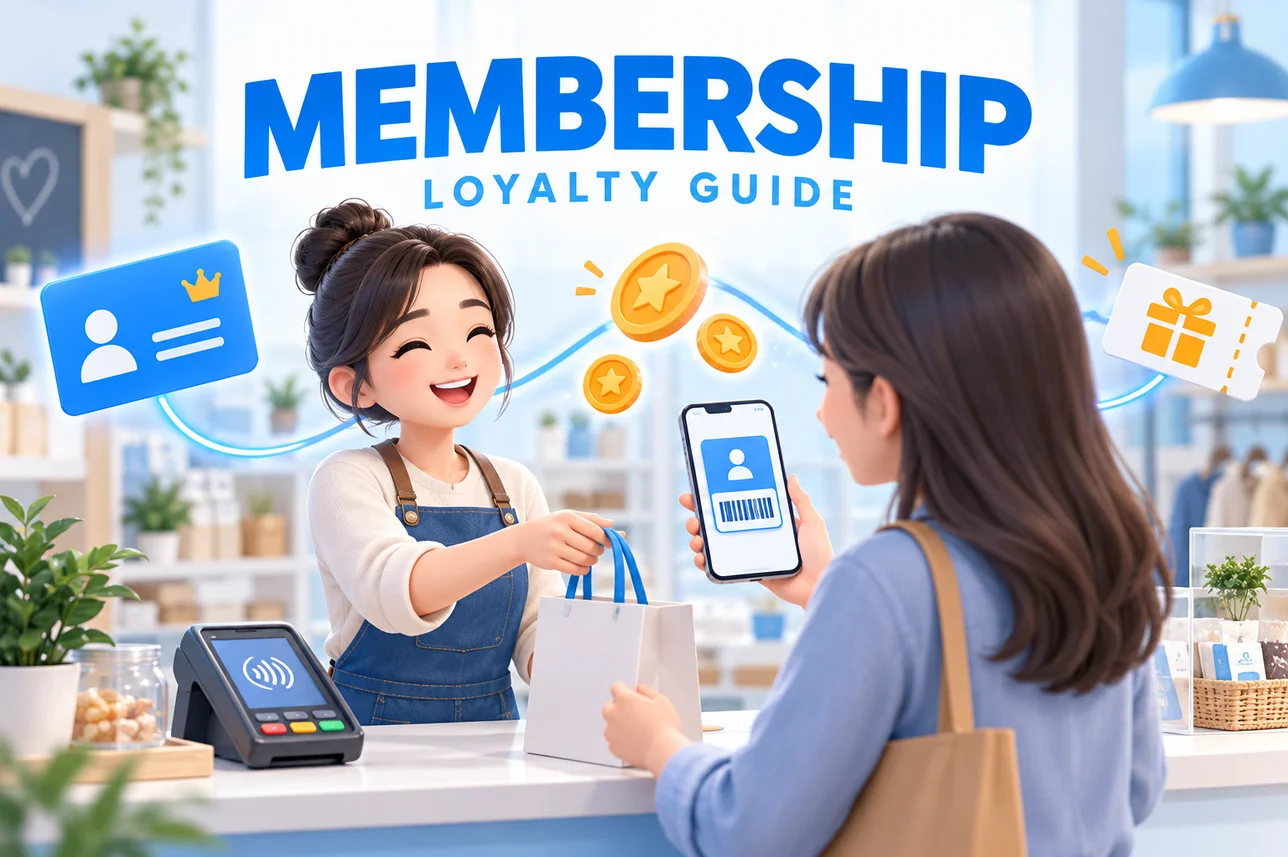
Choosing a retail membership system starts with why customers should return and how staff will manage their benefits. A suitable system should connect customers with purchases, make earning and redeeming rewards clear, and provide data for assessing whether results justify the cost.
This guide covers program design, access channels, total costs, customer-data checks, and demonstration preparation. All examples are evaluation frameworks, not confirmation of any provider's capabilities or prices.
Membership systems versus website registration
A retail membership or loyalty system connects member records, purchase history, points, coupons, and benefits to support repeat visits. Website registration primarily creates accounts, manages sign-in, and controls access, such as member-only content or order management. A website account does not automatically include points or benefits shared with physical stores.
Test the complete journey: registration before checkout, member identification on the sale, points awarded under the rules, balance and expiry visibility, and redemption on a later purchase. Returns must also adjust the associated purchases and points correctly.
CRM covers broader customer relationships, including interaction history and segmentation. A membership system may be part of or connected to CRM, but the specific service must be checked.
Which businesses suit membership programs?
Businesses with repeat-purchase opportunities and enough margin to fund benefits have reasons to consider membership. Design should reflect how and when customers buy.
Retail stores
Points based on net spending and next-purchase coupons are possible approaches. Define minimum spending, eligible products, and whether benefits combine with other discounts. Check whether the margin on regularly purchased products can support the rewards.
Restaurants
A program could reward visits rather than only spending, such as a special menu item after a defined number of visits. Decide whether one visit means one receipt or one day, and how split bills are treated.
Service businesses
Salons, car-care businesses, and other recurring services could track visits and provide benefits such as priority booking or additional services. Include staff capacity and labor costs in the design.
These are design examples, not confirmed product features. Review purchase cycles, margin per transaction, regular-customer numbers, and staff readiness. Fast point expiry may be unappealing when customers naturally buy infrequently.
Choose features according to business goals
Separate launch essentials from capabilities that can wait until the business has more data.
Registration and duplicate checks
Keep registration short and collect only necessary information. Decide how members are identified and how duplicate accounts across channels are detected. Test changed phone numbers, incorrect details, and duplicate accounts. Check who can merge accounts and what happens to purchases and points.
Digital membership cards
A digital card can identify customers and expose balances, tiers, or benefits where supported. Check what staff scan or search and whether valuable redemptions require additional verification.
Earning and redeeming points
Define eligible spending, rounding, expiry, excluded products, and redemption value. For returns, test both reversal of earned points and restoration of redeemed points. Agree how to handle a return after the customer has already spent the points earned from that purchase.
Coupons and tiers
Specify coupon eligibility, validity, usage limits, minimum spending, and stacking rules. For tiers, define upgrade criteria, assessment periods, downgrades, and benefit costs. Initially prioritize member identification, transactions, earning and redemption, audit history, and export. Detailed segmentation and multiple tiers can follow later.
Confirm service-specific capabilities through documentation or demonstrations, including the plan, limits, and extra charges. A general feature list is not proof that every system includes it.
Compare LINE OA, phone numbers, and apps
LINE OA and apps are access channels; a phone number is an identity attribute. A phone number can work with either channel rather than representing a separate system.
| Criterion | LINE OA | Phone-number identification | App |
|---|---|---|---|
| Registration | Check chat, menu, registration entry, and account linking | Enter a number and check for existing accounts | Assess download, registration, and login |
| Card and points | Check the destination page and repeat login requirements | Needs a member page or staff lookup | Check card, balance, and benefit navigation |
| Verification | Confirm which member owns the LINE account | Check OTP if used and number-change procedures | Check login, account recovery, and device changes |
| Communication | Check message types, limits, and charges | SMS may be available under service conditions | Check notifications and user preferences |
| Integration | Verify the backend and actual connectors | A phone number alone does not connect sales data | Verify backend and integration scope |
For LINE OA, test the path from adding the account to opening a card, including platform limitations and messaging costs. Knowing a member's phone number should not itself authorize point redemption. For an app, assess whether customers have enough reason to return, alongside download, login, update, and maintenance overhead.
For POS and online-store connections, confirm the actual product name, version, and plan. Specify data direction, transferred records, and synchronization timing, plus detection and correction procedures for delayed or failed transfers.
Membership costs and a 12-month budget
Total cost includes setup, recurring service, usage-based charges, and the membership program itself. Initial work may include configuration, program design, migration, and training. Check member, branch, user, and transaction limits and overage charges.
Separate LINE OA, SMS, and OTP costs by actual usage. Ask about POS, online-store and API integrations, customization, and maintenance.
Illustrative annual cost
These assumptions demonstrate the calculation only; they are not actual service prices. Monthly costs are assumed constant throughout the year.
| Assumed item | Calculation | Annual THB |
|---|---|---|
| Setup, program design, migration, and training | One-time | 12,000 |
| System subscription | 1,500 × 12 months | 18,000 |
| LINE OA messaging | 300 × 12 months | 3,600 |
| SMS and OTP | 200 × 12 months | 2,400 |
| Sales-system integration | One-time | 6,000 |
| Maintenance | 250 × 12 months | 3,000 |
| Rewards and discounts actually redeemed | 2,000 × 12 months | 24,000 |
| Staff time | 5 hours × 200 × 12 months | 12,000 |
| Total under these assumptions | 81,000 |
Tax, additional customization, and overages are excluded. Replace these values with quotations and business estimates, and distinguish cash payments from the opportunity cost of staff time.
Launch and connect the sales process
- Set a measurable objective, such as second purchases, frequency, or retention, and record a baseline.
- Design benefits around margins, product and service costs, and customer behavior.
- Document earning rates, redemption value, expiry, exclusions, returns, and point-adjustment approval.
- Choose registration and sale-matching methods, including whether retrospective claims are allowed.
- Confirm compatibility, exchanged data, synchronization timing, and error ownership with existing-system providers.
- Test registration, earning, redemption, cancellation, returns, and duplicates before a limited launch.
- Train staff with a short guide, support contacts, and procedures for helping customers during outages before expanding.
Record both data issues and extra checkout time during the pilot. Correct point calculations do not necessarily mean the staff workflow is convenient.
Customer data, permissions, export, and PDPA checks
List the data collected, its purpose, and whether it is necessary, including phone numbers, purchases, birthdays, and coupon usage. Define the purpose before adding registration fields.
For PDPA review, prepare questions about privacy notices, the processing basis for each activity, and consent handling where needed, including records and changes. These are topics for review rather than a legal conclusion about a particular implementation.
Test separate staff, manager, and administrator permissions: who can search members, adjust points, and export records? Ask about access and change logs and their retention periods.
Before selecting a provider, check:
- Export formats for members, purchases, points, and consent records.
- Export completeness, linking identifiers, and charges.
- Retention settings and handling after the retention period.
- Procedures and responsibilities for data-rights requests.
- Backup, recovery, and data return or deletion when service ends.
Before publishing business-specific legal details, review current official guidance and the actual business process so that statements match implementation.
Measure repeat purchases and prepare a demonstration
Evaluate outcomes connected to the objective rather than registrations alone. Keep definitions and observation periods consistent.
| Metric | Definition and scope |
|---|---|
| Repeat-purchase rate | Customers in the starting cohort who buy again during follow-up ÷ all customers in that cohort × 100 |
| Purchase frequency | Eligible orders ÷ purchasing members in the same period |
| Benefit usage | For example, redeemed coupons ÷ coupons issued in the same batch × 100, with a defined observation deadline |
| Member revenue | Net sales attributable to identified members, alongside discount and reward costs |
Give cohorts equal follow-up time. Compare new-customer cohorts only when each has completed the required window. Apply consistent returns, cancellation, and discount treatment to avoid distorted revenue or double-counted costs.
Compare similar customers and periods, accounting for seasonality, promotions, and price changes. Do not attribute all member revenue to the system: some customers would have purchased anyway.
Service information and demonstration preparation
Base decisions on confirmed plan capabilities, integration scope, pricing, limits, and support. Mark unsupported claims as pending verification. Prepare your business type, branch count, current sales system, goals, sample purchases, returns, and desired benefits so the provider can demonstrate realistic work.
Use demonstration channels confirmed by the service owner. The supplied guide does not establish any specific provider's contact channel, package, or price; verify those details before arranging a demonstration or agreeing to service.
Frequently asked questions
Do we need a retail membership system if our website already has registration?
It depends on whether the existing system supports points, benefits, and in-store purchase history. If it covers these needs and connects all channels, another system may be unnecessary. Otherwise, consider extending or integrating it to avoid duplicate member records.
Can LINE OA membership also use phone numbers?
Yes, if the system can link a LINE account and phone number to the same member record. Check phone verification, duplicate-account handling, and how staff find members during in-store purchases.
Can we choose a membership system based only on the monthly fee?
Monthly fees should not be the only criterion. Compare total costs, including setup, integrations, charges by member or branch count, essential features, and support after launch.
Can membership systems connect to every POS?
No. Compatibility depends on the POS version, available data interfaces, and both providers' limitations. Share the POS name and version, and request a demonstration of purchase transfer, point redemption, and returns before deciding.
What should we prepare for a membership system demonstration?
Prepare your business type, branch count, approximate member count, sales channels, and current POS name. Explain your objectives and intended rules, such as points, coupons, or tiers, so the provider can demonstrate realistic scenarios.